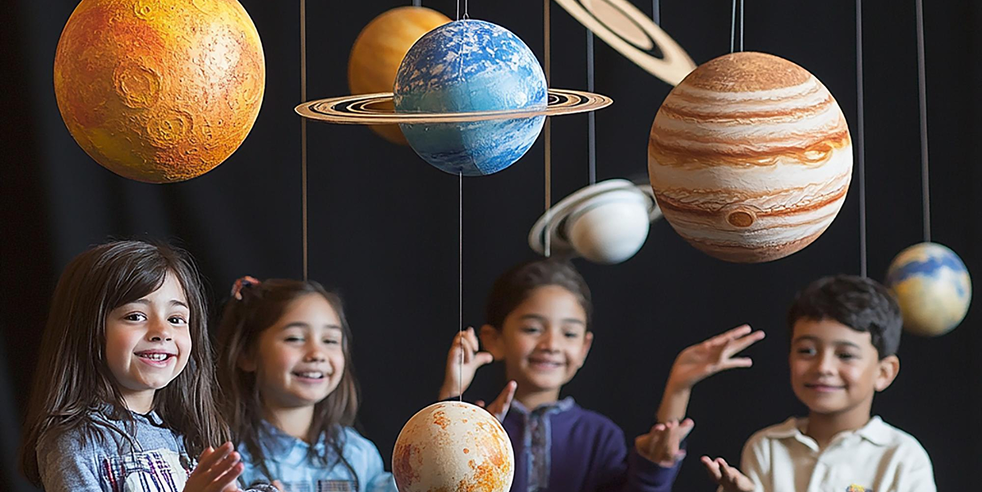
Space has always inspired curiosity, imagination, and discovery. It comes to no surprise that many high schools have to a degree subjects that introduces students to what lies beyond our planet Earth. From ancient civilizations studying the night sky to modern scientists launching space telescopes, humanity’s fascination with the universe continues to grow. One of the most exciting ways to begin exploring astronomy is by learning about the planets in solar system and how they orbit our Sun.
A planet is a large celestial body that orbits a star, has enough gravity to form a nearly round shape, and has cleared its orbit of other debris. In our solar system, the Sun is the central star, and the planets of the solar system travel around it in predictable paths called orbits.
In addition to full planets, there are also dwarf planets, such as Pluto, which orbit the Sun but do not meet all the scientific criteria required to be classified as full planets. Other objects like moons, asteroids, and comets also exist within our solar system, making it a dynamic and constantly moving environment.
Learning about the planets in solar system helps students understand Earth’s place in space, how planetary systems form, and why certain planets have conditions that differ dramatically from our own. By studying the planets of the solar system, we begin to understand the structure, scale, and diversity of our cosmic neighborhood.
In this article, we will explore:
The planets in solar system orbit the Sun in a specific order based on their distance from it. There are eight recognized planets, and in order from closest to farthest from the Sun, they are:
Mercury
Venus
Earth
Mars
Jupiter
Saturn
Uranus
Neptune
These planets are divided into two main categories. The first four—Mercury, Venus, Earth, and Mars—are known as the terrestrial planets because they are rocky and solid. The outer four—Jupiter, Saturn, Uranus, and Neptune—are classified as gas giants and ice giants, made mostly of gases and ices rather than solid ground.
Understanding the planets of the solar system is important because it provides foundational knowledge about astronomy. Each planet has unique features, climates, and compositions. Learning their order and characteristics allows students to compare planetary environments and better understand how our solar system formed over billions of years.
While our solar system is vast, it is only a small part of the universe. Beyond Neptune lies the Kuiper Belt, home to icy objects and dwarf planets. Even farther away is the Oort Cloud, a distant shell of icy bodies believed to surround our solar system.
Beyond our system are exoplanets—planets that orbit stars other than the Sun. Scientists have discovered thousands of exoplanets, some of which may have similarities to Earth. These discoveries expand our understanding of how planetary systems form and evolve.
Studying what exists beyond the planets in solar system is important because it broadens our understanding of space. It encourages students to think about life beyond Earth and consider the possibility of habitable worlds elsewhere in the galaxy.
Examples include NASA’s Kepler mission identifying Earth-sized exoplanets, the James Webb Space Telescope capturing images of distant galaxies, and ongoing research into black holes and nebulae. These advancements demonstrate that space exploration is constantly revealing new discoveries.
Memorizing the planets of the solar system can be fun and engaging with the right techniques. Mnemonics are one of the most popular tools used to remember their order.
A common mnemonic is:
“My Very Educated Mother Just Served Us Noodles.”
Each word represents Mercury, Venus, Earth, Mars, Jupiter, Saturn, Uranus, and Neptune.
This method is important because it simplifies complex information and improves long-term memory retention. When students confidently recall the planets in solar system, they build a strong scientific foundation.
Other helpful strategies include songs about the planets, interactive digital simulations, building physical models of the solar system, and using flashcards. These techniques make astronomy both accessible and enjoyable.
Each of the planets in solar system has unique characteristics that make it fascinating.
Mercury
Venus
Earth
Mars
Jupiter
Saturn
Uranus
Neptune
Jupiter is the largest planet in our solar system while Mercury is the smallest planet in our solar system. In recent studies, Pluto was reclassified as a dwarf planet as it does not meet the criteria of having a complete or concise orbit around the Sun.
These facts show the incredible diversity among the planets of the solar system. From scorching heat to icy winds, each planet presents a different environment and scientific mystery.
Learning about the planets in solar system opens the door to understanding the vast universe beyond Earth. By studying the planets of the solar system, students discover how planetary systems are structured, how Earth compares to its neighbors, and why certain planets have extreme environments.
From Mercury—the smallest planet—to Jupiter—the answer to what is the biggest planet in solar system—each world offers unique characteristics that spark curiosity and imagination. Exploring these celestial bodies encourages scientific thinking, problem-solving, and a deeper appreciation for our place in the cosmos.
Through engaging facts, memory tools, and expanding knowledge beyond our solar system, students not only learn astronomy—they develop a lifelong fascination with space exploration and discovery.
Looking to learn more about our solar system? You don’t have to venture to a galaxy far far away and learn about them from one of the best private schools in the Philippines. Find out more about what awaits students here at CISM at our admission page today!
Myles Pastor holds a Bachelor’s degree in Music and a Master’s degree in Teaching Early Grades. With 23 years of teaching experience, Myles brings creativity, warmth, and a deep understanding of early childhood education, nurturing young learners through music, movement, and meaningful classroom experiences.
From the sports field to the science lab, explore how our students are shaping their futures and building lifelong memories within the CISM community.